The second part of Media in Conflict took place amid lockdowns and travel bans, which posed challenges to international collaboration. Yet, during the past week four German-Ukrainian duos came together to exchange ideas, discuss, and tell stories about press freedom, identity, and diversity in the media.
An intense weekend packed with workshops, speakers, and discourse started off the project, which was organized in cooperation with the Centre for Civil Liberties Ukraine. Not only the organizers, but also the participants worked collaboratively. Together, the German-Ukrainian editor tandems exchanged ideas, conducted interviews, and finally wrote down their findings in reports, portraits, and feature articles here, on the politikorange blog. „I look forward to reading the final articles – they are all very different,“ said editor Lilian Sekkai about the results of the project.
Learning together
Over the course of the weekend, the participants were joined by Ukrainian journalists who talked about their work, about press freedom in the Ukrainian media landscape, and about the impact of war on journalism. The digital barrier did not stop speakers from engaging in a lively dialogue and impressing our editors with their insights. „It was three days of discovery,“ said editor Liidia Moshenska about the weekend.
Throughout the program, participants bridged culture and language barriers, and learned about media in conflict in Ukraine. „I gained knowledge about Ukraine and about writing in another language,“ said editor Benjamin Müller. „I found out that I enjoy writing in English.“ Even the Ukrainian participants left the project with new insights. „I learned new things about Ukraine. Now I understand my country a little bit better,“ said editor Yuliia Ivanchenko.
Values of multicultural collaboration
However, this project was not only about gaining knowledge or journalistic experience. It was also about cultural exchange. „Getting to know the Ukrainian participants and especially my tandem partner made me more interested in Ukraine,“ said editor Nicole Kauer. The project helped strengthen cooperation between young people interested in media affairs during such challenging times. The 8 participants worked on their articles together, and each team included participants both from Germany and Ukraine. This approach was crucial for multicultural exchange, to deepen the connection between two media communities, and enrich the understanding between participants from two countries.
2020, the digital year
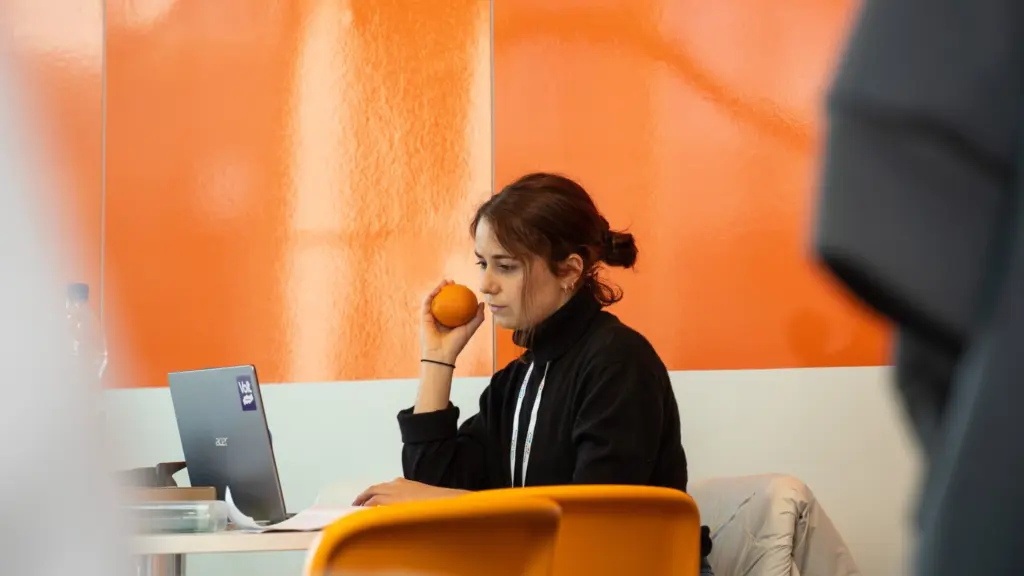
Working together online was a challenge for all participants and organizers. It felt different and a little weird, sitting alone in an empty room in front of an empty Zoom screen right before the project started. But as more and more smiling faces popped up on the computer screen, the awkwardness faded away and made room for a relaxed and welcoming atmosphere. „Even though we are on Zoom, it feels like we are offline. It is so immersive,“ said editor Hanna Nyzhnyk.
Discussing, writing, and getting to know each other is harder if your counterpart is some thousand kilometres and even a timezone away. Despite occasionally unstable internet connections, everyone made the best out of it. „All of us learned how to cooperate with each other, even though we never met in person,“ said editor Liidia Moshenska.
International teams, after coming through a cycle of the online lectures and training, were asked to choose the topic they continued to work on. The teams were also supported with editorial consultations during the week of writing. As people from different cultural groups work together, they unite the best from their values and communities. The main goal of the training was to create the bridge for partnership and higher understanding, despite the intercultural differences. Rather, our strength is in our diversity.
One last thing
Our Ukrainian editors wanted you to know that when writing about the Ukrainian capital, you should use Kyiv instead of Kiev. The word Kiev is derived from the Russian pronunciation of the capital. It symbolizes the so-called ‘Russification’, the ban of the Ukrainian language by Imperial Russia, and the Soviet Union that was used to strengthen their political positions in Ukraine. To emphasize Ukraine’s independence, use the city’s name in Ukrainian language: Kyiv.
The project was funded by Stiftung "Erinnerung, Verantwortung und Zukunft". The publications do not represent an expression of opinion by the Foundation. The authors are responsible for the content of their statements.