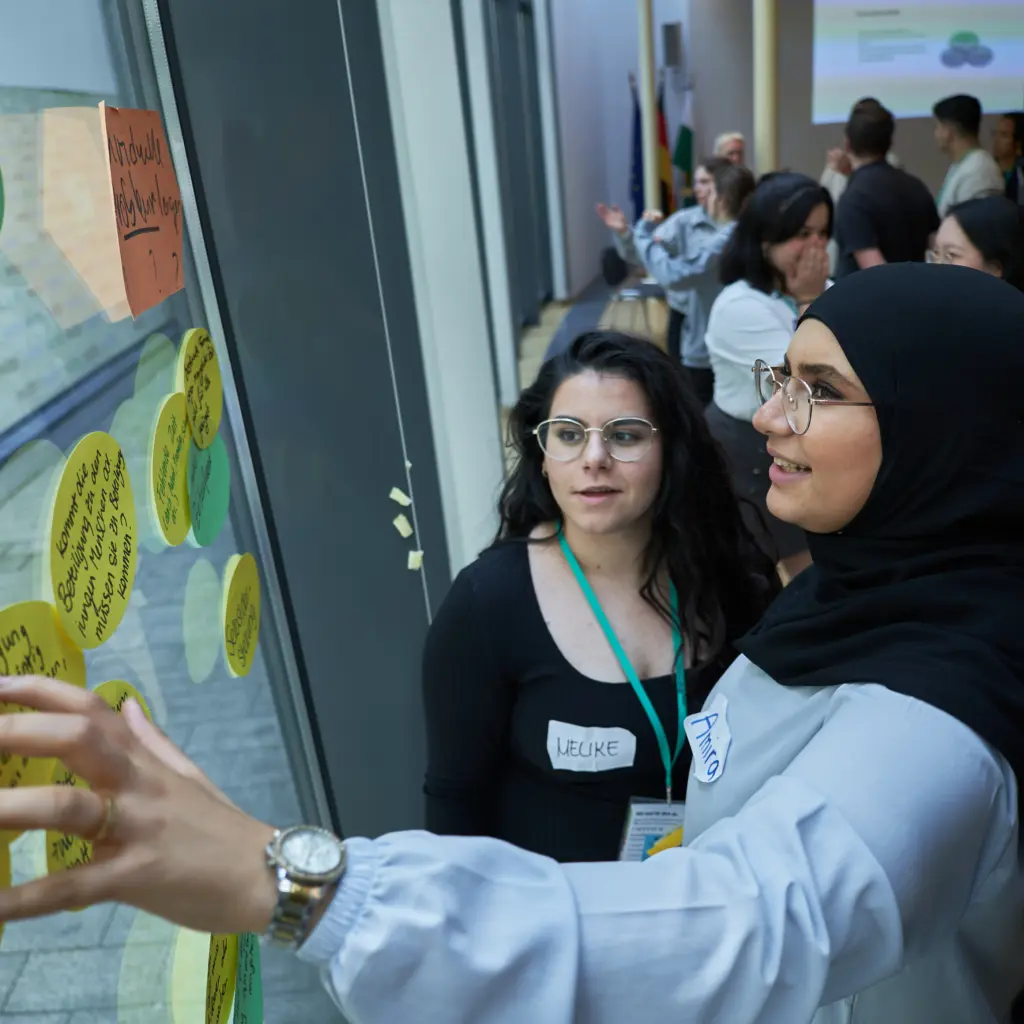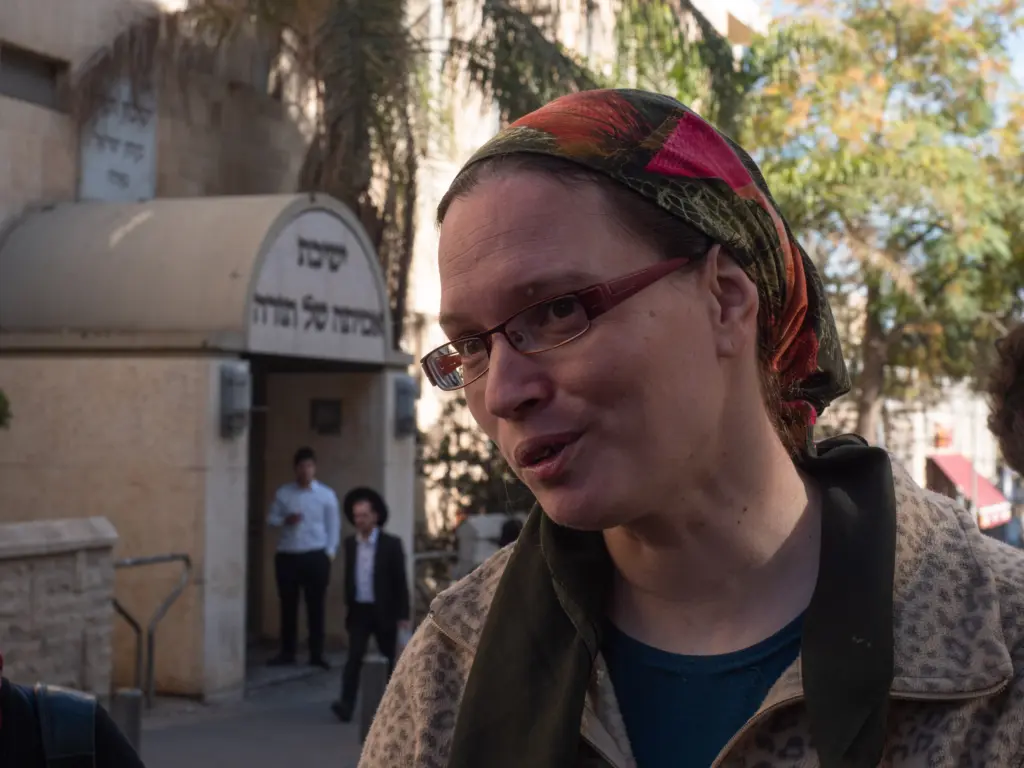
During the project „Research Identity“ in Israel and Palestine our reporters had the chance to meet with several, remarkable women. Hanna Hörnlein spoke with a Bedouin women and a German participant, among others, about their roles in society, their interactions with men, and how they are able to express their individuality. Which influences shape their identity? And how do we, as visitors, start reflecting on our own roles in this process?
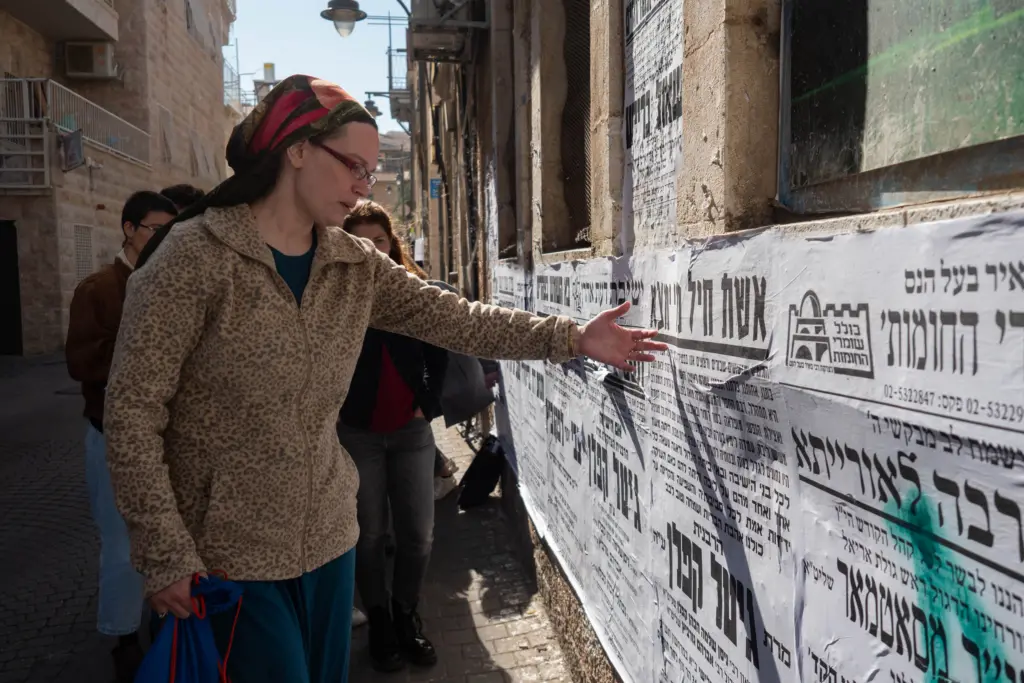
Tzipi explains the announcements on the walls of an ultra-orthodox neighborhood. Photo: Jugendpresse Deutschland e.V. / Mathias Birsens
Second Meeting: Tzipi Yarom – the definition of borders
Do you feel limited in your daily life? A strong question to start the interview with Tzipi Yarom, a Jewish ultra-Orthodox woman from the Haredim Mibfnim community in Jerusalem. „Not only women are limited“, she says; „It’s the religion that limits us“. Even if she would live on a lonely island, she would find herself following the rules that her ultra-orthodox belief imposes on her. Yet, she doesn’t feel locked up or limited, like I assumed in my question. She tells me that in her community, although it might seem different from the outside, women have the power. They run social projects, take care of the family, and work to earn money to feed their husbands and children.
Nevertheless, there are a lot of boundaries between women and men in communal places like the synagogue, shops, or even in movie theaters. Women and men pray separately, as we experienced at the Wailing Wall in Jerusalem. „Women can pray wherever they want, at the bus, at work – it doesn’t matter“ Tzipi explains, „but a man has to find another nine men to even start his prayers – in a synagogue, for example“.
Men are training themselves to prevent looking at other women. Women are wearing headscarves to signal that they are married and therefore unavailable. „We want to preserve the most beautiful part (the hair) for our husbands,“ Tzipi says. But it’s not only the headscarves. Walking through the streets of Haredim Mibfnim we noticed a lot of women having the exact same haircut. Wigs. „It’s a bit of a paradox,“ Tzipi admits. Wearing wigs to cover our own hair, with hair that is considered more beautiful – although the beauty of one’s own hairstyle „should be the most beautiful thing“.
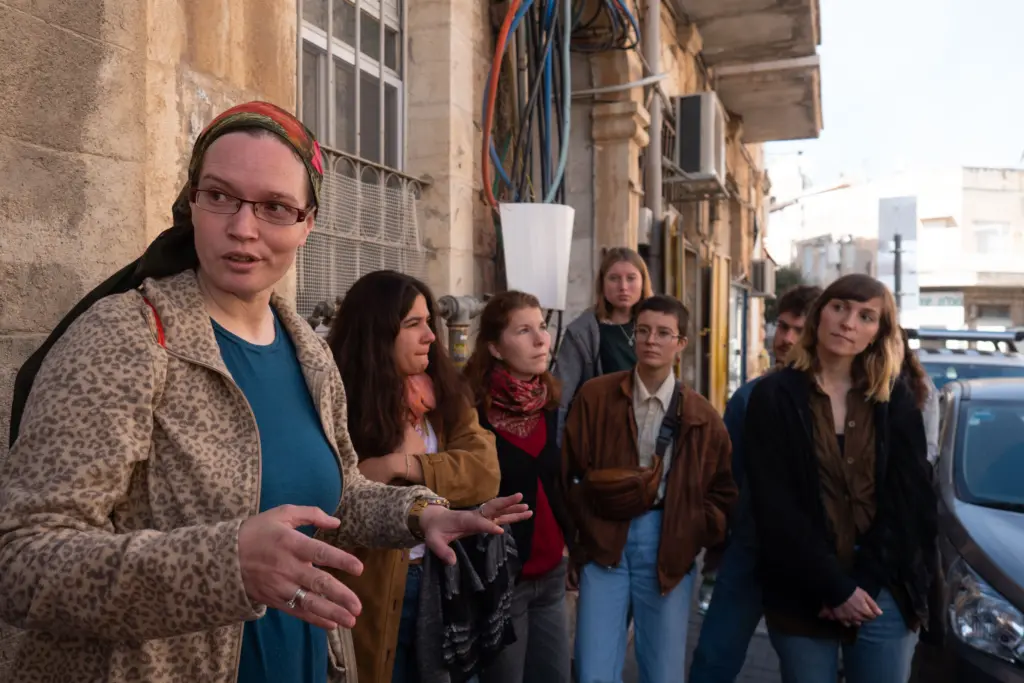
Tzipi shows the participants around. Photo: Jugendpresse Deutschland e.V. / Mathias Birsens
Since religion forms a big part of the ultra-orthodox Jews’ daily life, it’s interesting to understand the different ways that men and women study the holy book of the Jews: the Torah. In some communities, it is ideal for men to not work throughout their whole life, dedicating it to Torah study instead. Women learn about daily life issues written in the Torah. They know the conclusions extracted from the Torah, the rules for their daily lives and the speeches – it’s not at all a profession.
But, „when your husband learns, you are learning with him“. She describes marriage as a space for the exchange of thoughts. And she benefits from the studies of her husband. I asked her about the division of work in the household between her and her husband. Tzipi describes their schedule, who picks up the kids, who brings them to school, and so on. When she talks about their daily life it seems all very equal. And it has little to do with the division one might imagine when it comes to a strict religious household.
Seeing Tzipi Yarom managing her life makes me realize the prejudices one can have towards women’s roles in religiously shaped communities, and how self-perception matters a lot. Borders might be made up in the head.
Empfohlene Beiträge


Realität aus, Reality an – wie toxisch ist unser Verhältnis zu Reality-TV?
Dennis Stockfisch