„Think European – Act Local“ is the slogan of a new project on the occasion of the EU Trio Presidency. But to what extent is the Trio Presidency really „for climate“? Živa Zajc and Carla Moritz investigated this question.
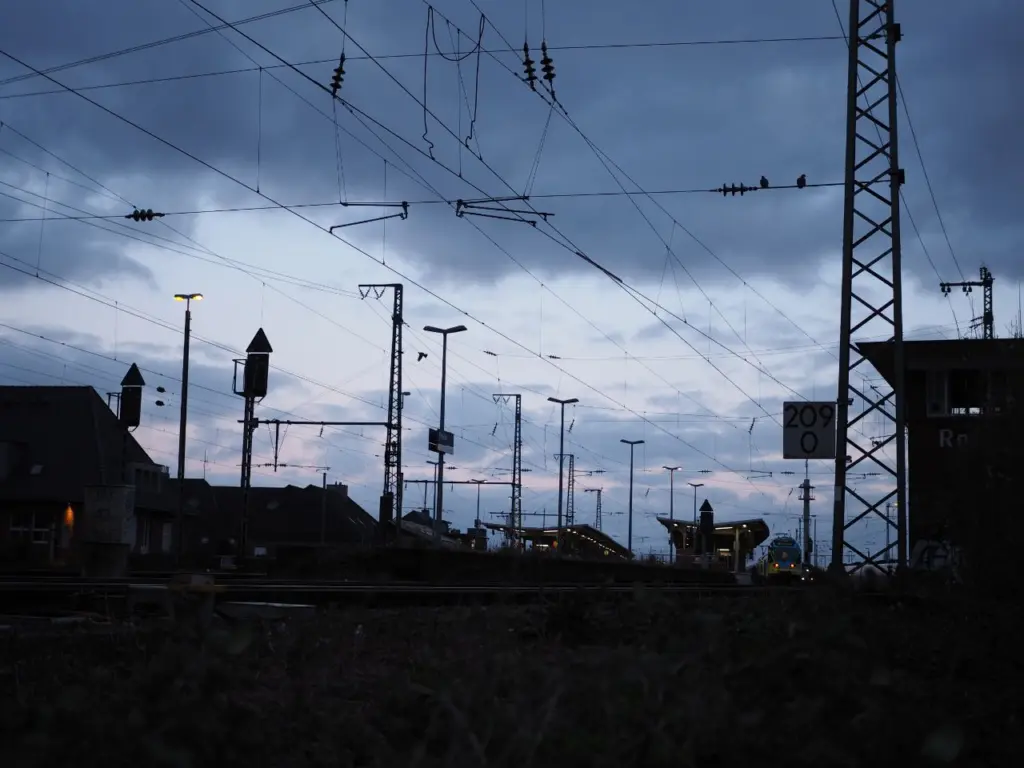
Rail transport and an energy union are to be among the main focuses of the Trio Presidency's environmental policy. Photo: Linus Walter
On 1 July 2020, Germany, Portugal and Slovenia took over the Trio Presidency of the Council of the EU for 18 months. On the agenda, the three countries have set common themes and priorities for this period. The project „Three Presidencies for Climate: Think European – Act Local“ aims to foster collaboration for climate protection on multiple levels. The project is working with the cooperation of German, Slovenian, and Portuguese schools and cities. But the climate policy of the Trio Presidency began much earlier in its agenda.
In the agenda, Germany, Portugal and Slovenia set common themes and priorities for their EU policies. These three countries will take over the Presidency of the Council of the EU for six months, one after the other. During those 18 months, they will work together as a trio to ensure continuity. According to Portuguese ambassador Francisco Ribeiro de Menezes, the agenda of the Trio Presidency is an „ambitious program“ to combat climate change. Slovenian Ambassador Franc But also emphasizes that „Slovenia, Germany, and Portugal are three environmentally-oriented states.“
As per their Agenda of the Trio Presidency, the Trio Presidency is committed to the Green Deal and intends to work towards „a climate-neutral Europe by 2050“ during its term of office. But how exactly do they intend to make the EU more climate-friendly between 1 July 2020 and 31 December 2021?
In the common plan for the one and a half year presidency, „Building a climate-neutral, green, fair and social Europe“ is stated as one of the five main objectives. More specifically, for the forthcoming EU presidencies, this means working towards a climate-neutral Europe by 2050, and the fulfillment of the Paris Climate Agreement. According to the three governments‘ plan, the transition should be „cost-effective, just, socially balanced, fair, and achieved in a way that preserves the EU’s competitiveness“.
Environmental goals published by the Trio Presidency
Until now, there have been no visible measures or strategies to reach the goals set in the agenda of the Trio Presidency. The actual program presents only a few proposed approaches.
The proposals are:
- Realization of the Energy Union: The Trio Presidency aims to realize a common, European energy market with a focus on sustainable energy. According to the consilium of the EU, one of the advantages of the Energy Union is the high potential for renewable energy sources. Phased excess energy from renewable sources, e.g. during strong wind, can be sold to other EU countries. Renewable energy from offshore wind power stations and hydrogen will be particularly supported, according to Dr. Susanne Hegels of the German Ministry of Economics and Energy.
- Transport: According to a publication of the transport ministries of the three countries, Germany, Slovenia and Portugal want to create „affordable and sustainable mobility“ during their presidency. They want to support the breakthrough of alternative driving systems and fuels. Additionally, the means of transport on rails and in water should be supported. The ministries of infrastructure of the three countries have agreed to „significantly further increase passenger numbers and the amount of freight transported by rail.“
- A „renewed sustainable finance strategy“: According to publications of the european commission, the aim of the strategy is to redirect private capital flows towards green investments and to encourage sustainable business management.
- Sustainable water management: According to the agenda of the Trio Presidency, they aim to support sustainable growth in marine and maritime sectors, and create a comprehensive Oceans Agenda.
- The Green deal: The 8th Environmental Action Programme – also referred to as the Green – deal should be brought to fruition. You can read more details about the goals of the green deal at the end of this article.
- Sustainable and circular agriculture, fisheries and food systems: The ministers of the Trio Presidency will focus on good, safe, and affordable food – to ensure ample supply in times of crisis, and sustain animal welfare. Moreover, they aim to further advance the Common Agricultural Policy (CAP), an EU concerning European farmers and society. Here, they intend to support the legislative proposals of the European Commission, and to change the Common Agricultural Policy in a sustainable way.
- Sustainable forest management: The three countries have agreed on a forest policy that emphasises the many services that forests provide, and which is based on the strengthened EU Forest Strategy post-2020. The European Commission will develop this strategy in the last quarter of 2020 to enlarge, protect, and improve forest areas.
Trio EU Presidency agenda receives criticism
As written above, there are few concrete strategies in the proposed policies. For example, although the transport ministries of the three countries are talking about an intended increase in the number of passengers on trains, no strategy is presented on how to achieve this. The German Federal Ministry of Transport has, to date, not replied to a request for comment.
Because of the unambitious goals and inaccuracies, the EU Trio Presidency faces criticism by environmentalists regarding their sustainability strategy. Former member of the Bundestag Hans-Josef Fell told the Euroactive Media Network that the program of the German EU Presidency has „no concrete statements, but overblown rhetoric that is not accompanied by sufficient measures, but with completely inadequate goals“.
Covid-19 crisis vs. climate crisis
There is, however, another problem which is more important for the three countries at the moment: the Covid-19 crisis. As this crisis brings additional economic challenges, the Trio Presidency intends to „implement all appropriate measures serving a robust recovery of the European economy“, but as stated in their agenda, „in line with a sustainable and inclusive growth strategy“. Therefore, investment in a sustainable economy should be considered in the reconstruction of the European economy.
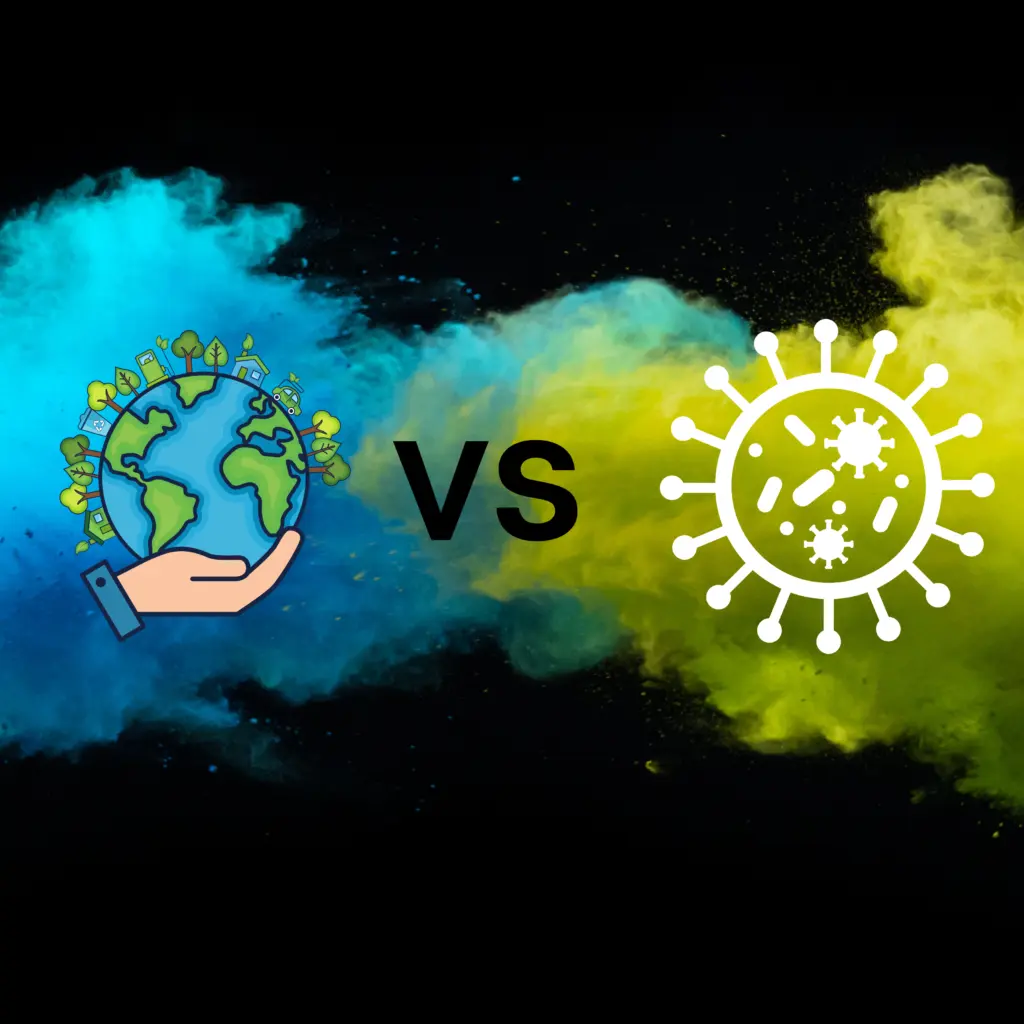
Are worries about the Covid-19 crisis overshadowing efforts to protect the climate? Image: Živa Zajc with Canva
Susanne Hegels from the German Ministry of Economics and Energy emphasises this as well: „Environmental issues have not become less important due to Corona. We see the green deal as an opportunity for the European industry and economic recovery and we should use the chance that we have now to make our economy more future-oriented and environmentally friendly.“
Even if environmental protection is taken into account while combating the consequences of the COVID-19 crisis, the focus of the Trio Presidency does not seem to be on sustainability. Interestingly, the word „climate“ is only used 13 times in the agenda, while „COVID-19“ is used 38 times.
Environment: A Lasting Issue for EU Policy
In contrast to the COVID-19 crisis, the environment is not a new topic for the EU. Europe has been fighting against environmental problems since the early 1970s. After the first UN conference on the environment held in Paris in 1972, an action program was mandated – however, it remains limited by the subsidiarity principle. This means that choices are made as close to citizens as possible, unless EU action is more successful than the measure at a national, regional, or local level. This applied for a requirement of consent in the Council, with regard to fiscal matters, town and country planning, land use, quantitative water resource management, choice of energy sources, and structure of energy supply.
The first legal basis for a common environment policy came with the Single European Act in 1987, which was introduced as new Environment Title. It included the aims of preserving the quality of the environment, protecting human health, and ensuring rational use of natural resources. Until today there have been seven, environmental action programs. In this overview we have summarized the seven programs from 1973 until 2030:
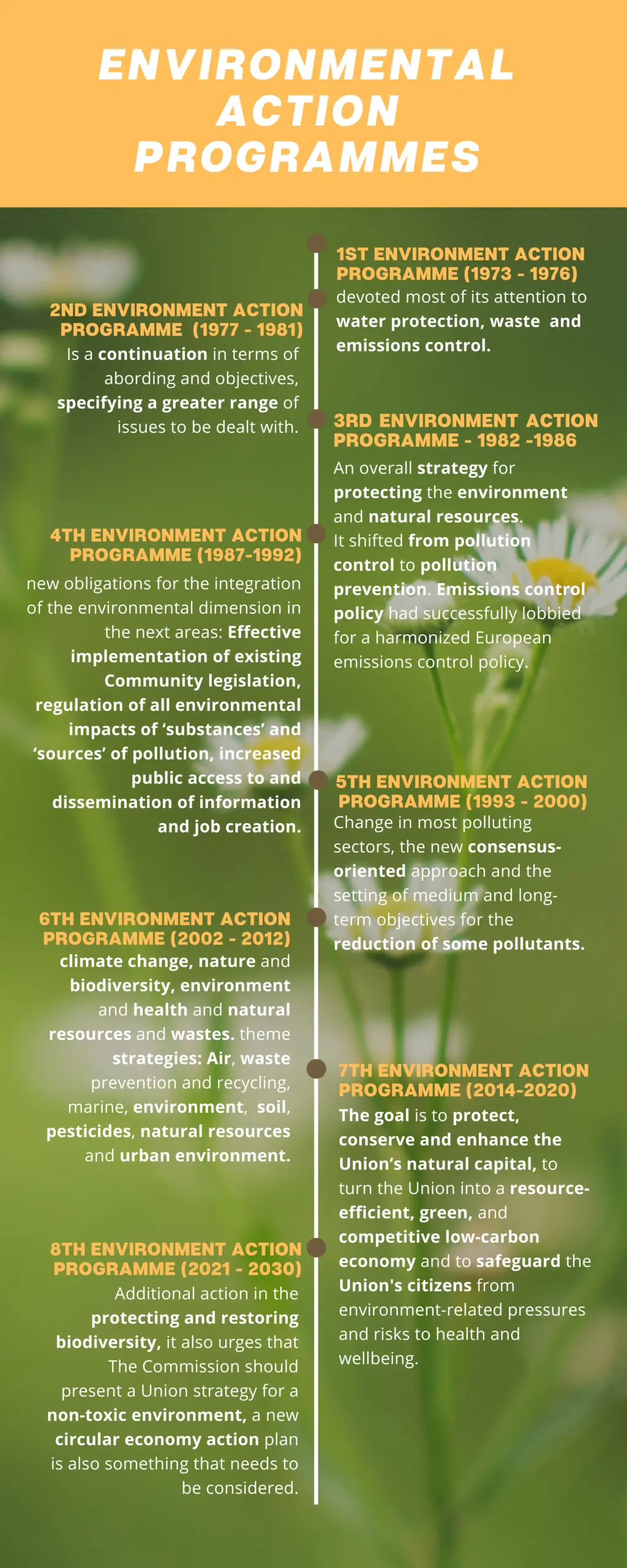
The Green Deal – a guideline for the environmental policy of the Trio Presidency
On December 2019 the European Green Deal was presented the first time. It is the 8th Environmental Action Programme and the consequence of some environmental issues, which have recently risen to new heights. The deal is affecting economies and policies worldwide. Its goals are that there will be no net emissions of greenhouse gases by 2050, that economic growth will be decoupled from resource use, and that no person and no place will be left behind. This deal presents a plan to boost the efficient use of resources by moving to a clean, circular economy, to restore biodiversity and cut pollution.
However, the plans of the EU are not cheap. The EU Budget for Climate and Environment is set for 503 billion euros. According to the official website of the EU, the climate and energy target for 2030 will require additional investments of 260 billion euros a year by 2030. The success of the plan to be climate neutral in 2050 in all sectors of the economy, depends on the actions taken for environmentally friendly technologies, on decarbonizing the energy sector, and on the construction of energy-efficient buildings. The EU will also carry out a series of initiatives that aim to protect the environment and boost the green economy, like the Climate Pact, the program „From Farm to Fork“, the European Climate Law, Circular Economy Action plan, clean energy and many others.
In the end, the Green Deal is like a guideline for the environmental policy of the Trio Presidency. However, it remains open whether the measures presented by the three countries are sufficient to work towards the objectives of the Green Deal. If this is not the case, it will be difficult to describe it as a „green“ Trio Presidency „for climate“.
Empfohlene Beiträge

A New Rhetoric: The EU’s Shift Towards a More Courageous Attitude Facing China
Valentin Dreher