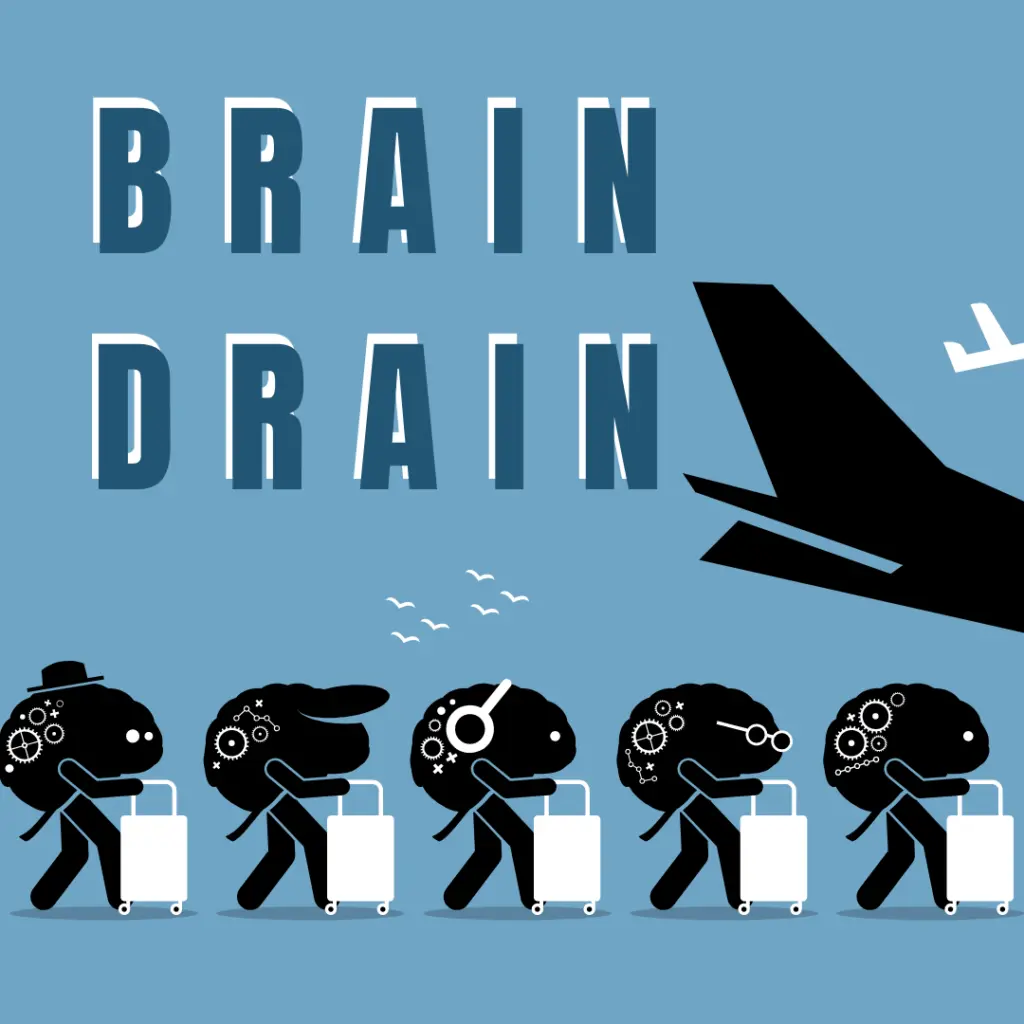
Where red turnpikes used to appear as obstacles, nowadays you won’t even notice crossing borders within the EU. This freedom of movement is one of the big changes brought to the European Union through the Schengen ratification. But it also presents a major risk to many European member states: the so-called „Brain Drain.“
The 18-year-old Bosnian Aziz Sahbazovic sighs: „People are just going. They don’t care where.“ Ninety percent of his friends have already left their home country. While talking, the boy in the blue shirt is sitting in front of a landscape painting. Currently, he and his sister live in the flat by themselves. Their parents work abroad in order to pay the bills. Aziz himself is about to leave. In the fall, he hopes to study at a college in Washington, USA. The 18-years old boy identifies the lack of job opportunities as a central motif. „I am really lucky to have been hired for a summer job.“ The boy, who has been chosen as one out of thirty for an international school in Mostar, spends his holidays selling phone cases. The Brain Drain – Talentabwanderung in German or Beg mozgamov in Slovenian – is a widespread phenomenon in Europe. According to a report from the University of Porto, the term effectively describes the migration of talented young workers out of less developed countries to more developed countries. At first glance, it seems to be generally positive. When Germany calls for qualified workers, why not fill a scarcity with motivated and trained foreigners? Usually, the educated immigrants enhance their lifestyle and job prospects as well. Remembering his own friends who have moved abroad, Aziz has accepted the situation: „I know that they are happy now and live in a better surrounding.“ He still misses them of course. What Aziz noticed is a sort of a spiral of emigration. „Outside of the tourist season, the streets in my home village are empty at night“, he explains. When young people choose to go, the local budget shrinks and likewise, the living standard. Impeded by corruption, as he says, those teenagers wouldn’t start up their own local ventures, but head instead for Germany, Austria, or Slovenia. Aziz’s friends are not the only ones. Eastern countries within EU borders lose large numbers of citizens each year as part of labor migration, many of them highly educated. On the other side, the federal government of Germany proudly publishes the number of 28,000 inbound skilled immigrant workers received in 2017.
Economical losses by the Human Capital Flight
Germany will hold the EU council presidency for a 6‑month period starting in July 2020, and will be in a position to influence the topical agenda of the EU significantly. Together with co-presidency holder nations Slovenia and Portugal, the three nation will aim to develop a common program by the end of 2020. So far, the controversial Brain Drain topic has been largely left off at the European legislative level.
Franc But, Ambassador of Slovenia in Berlin, does not see the Brain Drain as a problem in his country: „About 60,000 people from Slovenia live in Germany right now.“ Instead he points his finger toward neighbouring states. While young migrants work abroad, society changes back home.
The term „Human capital flight“ further illustrates the situation. This refers to the migration of citizens who have received advanced training. Home countries pay for their citizens‘ kindergarten, primary schooling, and university. In this manner, the loss is financially quantifiable. A study led by Luisa Cerdeira, auxiliary professor at the university of Lisbon, calculates the total public loss as a consequence of one, educated female citizen emigrating from Portugal at 28,723 USD. This number includes missing tax revenue, as well as direct public spending on providing free training. Aziz Sahbazovic recalls one acquaintance graduating from public medical school in Sarajevo, and then applying to work in a German hospital.
Axel Stammberger from the German Ministry of Women, Youth and Gender Equality describes the German position on the subject as difficult. „Of course the German economy also profits from this movement“, he says. Indeed, in this conflict Germany takes the winner’s share. The medical field that has been a recent focus of the media. Alongside a high demand for foreign nurses, the number of immigrant doctors in Germany has risen noticeably within the last decades, according to data presented by the federal german medical association. Other numbers provided by the Friedrich-Ebert-Stiftung recite the same story. From 2000 to 2014, the number of Hungarians working in other EU states has multiplied by nine.
About a process and its long-term impacts
The Brain Drain issue was written into the 2018 agenda of the Bulgarian presidency thusly:
Alongside fostering new, highly-skilled generations of researchers and innovators across the EU, the Bulgarian Presidency will aim to pursue a fruitful discussion on and resolution of the brain-drain phenomenon, in particular in lagging EU Member States and regions, which young, highly-educated people tend to leave so far.
This does not come out from nowhere. As indicated by the United Nations, from 2000 to 2018, the Bulgarian population is estimated to have been reduced by approximately 1 million people.
The demographics have also changed. While the total proportion of 10 – 14 year olds has remained steady, the elderly population has grown considerably in size. Data from the world bank shows that the number of working-age Bulgarian citizens has declined, which might be read as a sign of the Brain Drain. After their six month tenure, Bulgaria passed the presidency and the topic on to Croatia, another member state faced by a migration exodus.
Whereas the Bulgarian presidency was focused on the topic of Brain Drain, Germany sets the emphasis on increasing the mobility of young people. Axel Stammberger, does not see the origin of the problem within Erasmus+ or other youth encounters. „The EU-programs like Erasmus have so many positive effects on young people“, he elaborates. In his opinion, vocational trainings only have minor effects on the phenomenon. According to the 2018 annual report on labor mobility, 51 percent of the survey participants define employment opportunities as the main factor, and the promise of higher pay being a core motivation. Second place is taken by family reasons, followed by academic pursuits. Inequalities in these areas are not easy to overcome. Franc But summarises the conflict thusly: „We are always trying to improve life in all the areas, but this is a long-term strategy with long-term effects.“
If Aziz could write a policy himself, he would invent one to decrease bureaucracy and fight corruption. „All this paperwork almost makes it impossible for foreigners like the European Union to invest in Bosnia.“ Regarding a possible EU membership for Bosnia, he would assume that the government might receive more funding. „Then again even more might leave“, he comments. Since Bosnia is not yet part of the European Union, Bosnian citizens are only allowed to remain in EU countries for up to 90 days, which equals a tourist visa. In order to receive a residence permit in the EU, employment is required.
Lots of Problems – Few Solutions
Since free movement is basically a human right, it is complex to tackle the task. The Business Club of Slovenia puts forward the idea of improving the housing situation. While housing concerns might not be the central cause for more than 11,000 young people leaving Slovenia between 2014 and 2018, the burdensome situation surely contributes to emigration. Another idea proposed is to build up tax incentives to motivate young Slovenians to return to their home countries.
Education also bears opportunity. Aziz Sahbazovic says he used to hate Bosnia, the country whose poor economic situation forced his father to work abroad multiple times a year, leaving his family frozen in fear. While at the international school in Mostar, however, he discovered a unique potential for Bosnia and learned to love his nation. What has helped him is having an increased understanding of local history in comparison with other states.
In 2018, Bulgaria kicked off a campaign emphasising education in its national budget, and offering specialist vocational trainings. The government has also reduced the number of hurdles for immigrant workers who are members of Bulgarian minorities, thus enforcing Brain Drain to its nearby states. However, none of these measurements have reached a European level yet. „In the end, this economic responsibility in the first place lies in the national government. It lays in the responsibility of the countries“, Dr. Susanne Hegels says.
As an employee of the ministry of energy and economics Dr. Hegels has been involved in preparing the sessions for the trio presidency, one of which is „cohesion“. This term implies further funding for structurally less privileged reasons. Opposed to that is Germany’s call for AI specialists to land here, as written in another paper from 2018 by the ministry she works for. Dr. Susanne Hegels does not find this necessarily problematic. „Especially in the digital field, there might not even be a need to move. Regarding common European projects it is the intention to work together.“
„It is always difficult to find a balance in this topic because the interests of the economy in Germany will always be different than the interest of the economy in Bulgaria“, Axel Stammberger from the youth ministry explains. In the meantime, Aziz has set his eyes sharp on returning to his home country. „I still have hope“, the young man in the blue shirt says. Talking about the place where he grew up, his eyes turn gloomy and he mentions a beautiful river, untouched nature, and perfect conditions for producing wine. When he thinks of Bosnia in fifteen years, he dreams of it using its full potential. Maybe by then, the chemical researcher will have founded his own wine company in the region, and in doing so, giving other young people a reason to stay. Before that, though, he is going to fly over the Pacific, where his chances are best.
Links with further information:
https://www.statista.com/statistics/582146/foreign-doctors-germany/ https://library.fes.de/pdf-files/id/ipa/12032.pdf https://countrymeters.info/de/Bulgaria https://www.statista.com/statistics/373486/age-structure-in-bulgaria/ https://www.ft.com/content/51f1bd86-d6cc-11e7-ae3e-563c04c5339a https://www.bmi.bund.de/EN/topics/migration/immigration/labour-migration/skilled-immigration/skilled-immigration-node.html;jsessionid=DF6357246FB6B7AE498D357C64E5B6E7.1_cid373 http://library.fes.de/pdf-files/bueros/sofia/15336.pdf